More detail on Chris Robinson's summer course:
WGSS 396: Studies in Gender and American Popular Music
Notions of what it means to be a man or woman, what is considered masculine or feminine, and a musician’s gender, sexuality and race dictate not only how a musician constructs and perceives his or her own music and image, but also how the American public, their fans and the music industry perceive and accept or disavow the musician and their music. This course will examine the importance of, and the roles that gender, femininity and masculinity have played in shaping numerous aspects of 20th Century American popular music. Central to this course will be how gender roles and perceptions have been socially constructed and perpetuated in American culture. The intersectionality of race and gender will also play a central part in this course. As common gender paradigms change over time this course will place gender, masculinity and femininity in social and historical context to better understand the cultural processes at work. In addition to gender, power, politics and economics play crucial roles in shaping the discourse surrounding musicians, their music, and American cultural conceptions of gender. This interdisciplinary course will draw on disciplines, methods and approaches that include history, musicology, gender and race theory, English, African American Studies, Jazz Studies, semiotics and material culture studies.
Tuesday, April 12, 2011


Monday, April 11, 2011
More summer course options
AMS will cross-list two courses with Women, Gender, and Sexuality Studies taught by our very own graduate students, Rachel Vaughn and Chris Robinson. Look for these as sections of AMS 344 on the summer schedule:
Rachel will teach Public Health, Sanitation & the Body in the June term, ending July 1. The class meets daily from 2:10-4:20.
Chris will teach Gender & Popular Music during the July term, from July 5-27. This course meets from 4:10-7:00 Monday, Tuesday, and Wednesday only, at the Edward Campus in the Kansas City area.
Either course would be an excellent addition to a related AMS major concentration- don't forget, you can also get junior-senior hours while treating yourself to instruction from some of American Studies' finest.
Rachel will teach Public Health, Sanitation & the Body in the June term, ending July 1. The class meets daily from 2:10-4:20.
Chris will teach Gender & Popular Music during the July term, from July 5-27. This course meets from 4:10-7:00 Monday, Tuesday, and Wednesday only, at the Edward Campus in the Kansas City area.
Either course would be an excellent addition to a related AMS major concentration- don't forget, you can also get junior-senior hours while treating yourself to instruction from some of American Studies' finest.
Wednesday, April 6, 2011
AMS 100 available for summer

Funding has been approved for a full slate of summer courses at AMS, including the lover-level cores. Get started or catch up on the major requirements, or get your Humanities distribution credit with AMS 100 Introduction to American Studies. Click the flyer for a closer look at GTA Jordan Wade's version of the course.
AMS will be offered in two sections- one that meets only June 7-July 1, and the other that meets only in July. Each course meets for two hours a day.
For more summer offerings, check http://classes.ku.edu.
Art and Popular Culture of Kansas
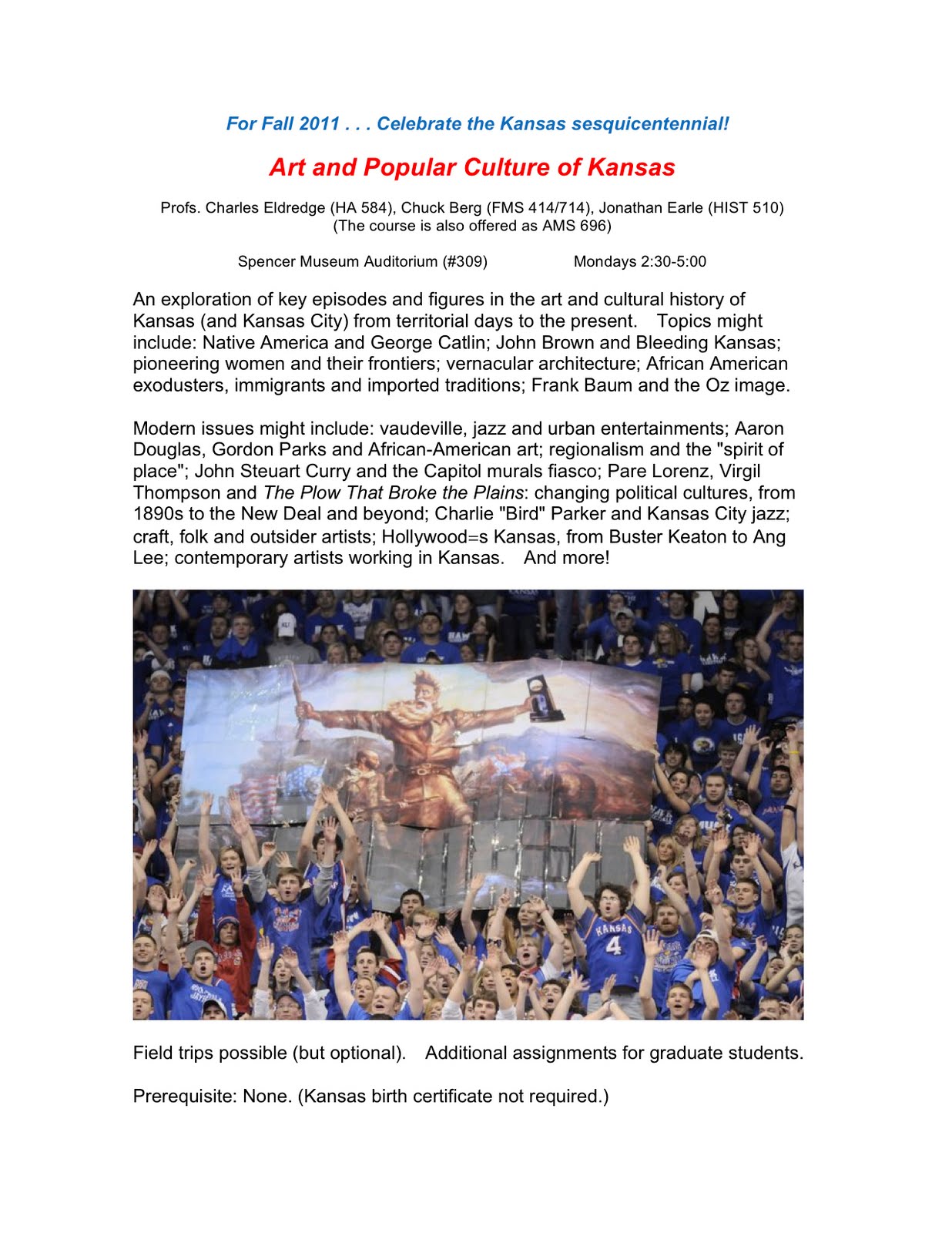
Continuing the tradition of innovative, interdisciplinary cross-lists, AMS is proud to add to our schedule a collaboration by an all-star team of affiliated facutly members including Charles Eldredge (History of Art), Chuck Berg (Film and Media Studies), and Jonathan Earle (History).
"Art and Popular Culture of Kansas" will be offered in fall, Mondays from 2:30 to 5:00 under the AMS 696 number. Click the flyer for a closer view.
New Course- Film Noir

Once again for fall 2011, Film and Media Studies faculty member and friend of AMS Ron Wilson will expand our offerings with a cross-listed course, Film Noir. Here's what Dr. Wilson has to say about the topic:
Murder. Lust. Greed. These are just some of the themes that characterize film noir, one of the most resilient genres in the history of cinema. And yet film noir—a category of film associated with a cycle of films that emerged in the 1940s—is defined by more than just such themes; it’s also characterized by a particular visual style and narrative structure that reflect the social, political, and cinematic context of the period. In this course we will watch a variety of noir films in order to consider film noir’s literary roots, its cinematic antecedents, its status as a genre and its enduring appeal. Questions about genre, visual style, narrative form, sexuality, gender, and American national identity will inform readings, lectures, and discussions.The course meets Mondays from 2:00-5:20.
Find it on the schedule under AMS 696.
Monday, November 15, 2010
Grad seminar in race and racism
Grad. students will all want to check out Tanya Golash-Boza's seminar for spring, which will provide outstanding interdisciplinary background in the study of race and racism. She says:
Readings will include:
Audrey Smedley (2007) Race in North America
Stephen Gould (1996) Mismeasure of Man
Ian Haney-Lopez (2006) White by Law
Matthew Frye-Jacobson (1999) Whiteness of a Different Color
Omi and Winant (1986) Racial Formations
Oliver and Shapiro (2006) Black Wealth/White Wealth
Michele Alexander (2010) The New Jim Crow
Devah Pager (2009) Marked: Race, Crime, and Finding Work in an Era of Mass Incarceration
Ann Arnett Ferguson (2001) Bad Boys
Prudence Carter (2007) Keepin’ It Real
Eduardo Bonilla-Silva (2009) Racism without Racists
Patricia Hill Collins (2005) Black Sexual Politics.
In “Contemporary Race and Racisms,” we will read in history, sociology, anthropology, and ethnic studies about the formation of the idea of race and the reproduction of racial hierarchies at the individual and institutional levels. By beginning with the creation of the idea of race in the seventeenth century by Enlightenment scholars, we will learn how the idea of race was created by Europeans, and, consequently, was created to benefit Europeans. Students also will perceive that the benefits accrued to Europeans and their descendants through racial ideologies is constant – even as the idea of race changes over the centuries. This class has at its core the importance of the idea of race in the contemporary United States. We will focus on themes such as mass incarceration, color-blind racism, racial inequality in the education system, racial differences in wealth and income, and how race, class, gender and sexuality work together to define social boundaries in our society.
Readings will include:
Audrey Smedley (2007) Race in North America
Stephen Gould (1996) Mismeasure of Man
Ian Haney-Lopez (2006) White by Law
Matthew Frye-Jacobson (1999) Whiteness of a Different Color
Omi and Winant (1986) Racial Formations
Oliver and Shapiro (2006) Black Wealth/White Wealth
Michele Alexander (2010) The New Jim Crow
Devah Pager (2009) Marked: Race, Crime, and Finding Work in an Era of Mass Incarceration
Ann Arnett Ferguson (2001) Bad Boys
Prudence Carter (2007) Keepin’ It Real
Eduardo Bonilla-Silva (2009) Racism without Racists
Patricia Hill Collins (2005) Black Sexual Politics.
Asian Women in Diaspora
Our colleague Ayu Saraswati has passed on the flyer for her course, which will be a great one for AMS majors interested in these transnational questions of identity and gender. Click on the image to see it big.


Subscribe to:
Posts (Atom)

 Posts
Posts


